Close X

How Homestead Removes Barriers to Care Before They Appear

How Homestead Removes Barriers to Care Before They Appear

Clear the Path™ – A Productive Approach to Provider Relations

When employers consider a referenced-based pricing (RBP) plan, one concern comes up repeatedly: Will my employees be able to see their providers?

It’s a fair question, and one that often reflects broader uncertainty about access and potential disruption.

At Homestead, we believe access shouldn’t be left to chance. That’s why our open access plans include convenient access to more than 700,000 physicians, specialists and ancillary providers through Prime Health Services’ Physician Only Network (PON).

We also help members see the providers they choose through our Clear the Path program, a proactive approach to provider relations designed to remove barriers before members ever need care.
 

What “Clearing the Path” Actually Means

Clear the Path isn’t reactive. It doesn’t start when a claim is denied or a member is frustrated. Clear the Path is proactive and starts before the plan goes live.

Our Provider Relations team uses historical claims data to identify the providers members already rely on most. We proactively confirm continued access well in advance of the plan’s effective date, allowing potential issues to be identified and resolved early.

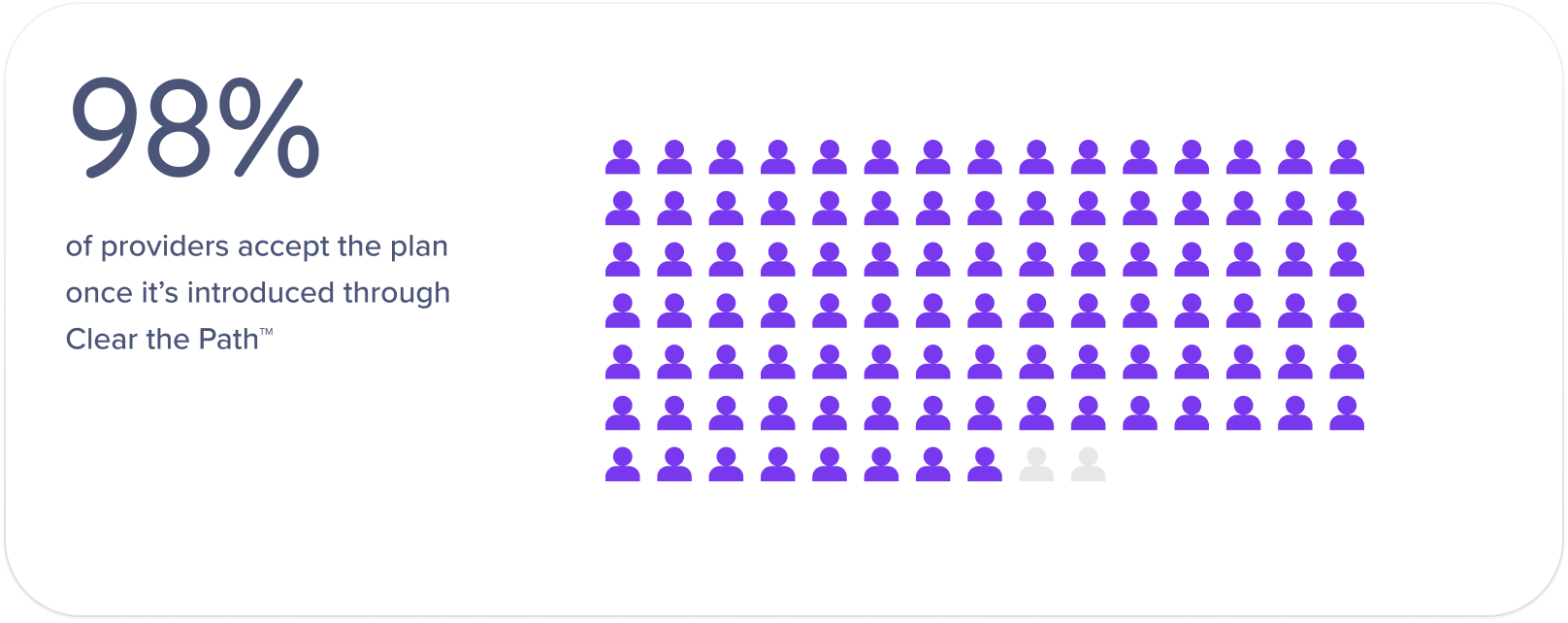
This approach is a key reason Homestead consistently achieves a 98% provider acceptance rate.
How Proactive Provider Outreach Works

Here’s what happens behind the scenes:

  • Claims history helps us identify the providers most important to members.
  • Providers are then grouped based on whether they already participate in Prime’s national network.
  • For providers outside the network, we then check whether Homestead has prior experience working with them.
  • If a provider is outside the network and we have limited or no prior experience, our team reaches out directly to explain the plan and confirm how claims will be submitted.
  • Our team explains the reimbursement approach and confirms the provider’s willingness to accept the plan.
  • Once outreach is complete, we communicate back to the employer, and support member communication as needed, so they know the path has been cleared prior to the effective date.

Providers aren’t asked to “figure it out”, they are supported through clear communication.
 

Questions Brokers & Employers Hear Most

Clear the Path exists because we understand the concerns and we’ve built the process to answer them directly.

Q: What if a large hospital says they don’t accept RBP?

Provider acceptance is rarely a binary yes or no. Our team engages in education, clarifies reimbursement expectations, and explores solutions such as prior experience, alternative facilities, or targeted agreements when appropriate.

Q: What happens if a provider doesn’t accept the first payment?

If questions arise after care is delivered, our team steps in to manage communication, address concerns, and protect the member from disruption.

Q: How do you mitigate balance billing risk?

In the off chance a balance bill happens, Homestead handles outreach, negotiation, and resolution. Members are never left to handle the situation on their own.

Q: Can you do direct contracting if needed?

Yes. In certain circumstances, contracting with anchor facilities can be an option when it supports access and member needs in a specific market.
 

Why Provider Relations Is the Linchpin of RBP Success

Reference-based pricing works when provider relations are strong. Clear the Path connects strategy to execution, ensuring that pricing models are supported by real conversations, real outreach, and real follow-through. It’s the difference between a plan that looks good on paper and one that works in practice.

For brokers, this means confidence in addressing objections.
For employers, it means reassurance that access remains intact.
For members, it means fewer barriers to care.

Interested in partnering with us?

Let’s build a smarter, more sustainable health plan together.

Fiduciary Lawsuits and Increased Scrutiny of Health Plan Costs

Fiduciary Lawsuits and Increased Scrutiny of Health Plan Costs

The Consolidated Appropriations Act of 2021 (CAA 2021) opened the door to class action lawsuits against employer-sponsored health plans in several ways. Most notably by expanding fiduciary obligations, increasing required disclosures, and creating a paper trail that plaintiffs can exploit.

Now, the recent surge in lawsuits focusing on ERISA fiduciary obligations is proving that plan sponsors concerned about their litigation risk had right to be worried.

Plan participants and plaintiff firms are increasingly alleging that employers:

  • Overpaid for healthcare services by not properly evaluating vendor pricing
  • Breached fiduciary duties by ignoring conflicts of interest
  • Failed to act prudently in selecting or monitoring PBMs or other vendors

The most significant example so far is the Johnson & Johnson (J&J) lawsuit. Originally filed in February 2024, this new and novel legal case argues the company failed their “duty of prudence” when selecting a pharmacy benefits manager (PBM) and negotiating drug pricing.


Lewandowski v. Johnson & Johnson: A Wake-Up Call for Health Plan Fiduciaries

Overview: This class action lawsuit filed by a J&J employee principally involves mismanagement of prescription-drug benefits. The lawsuit claims J&J breached their fiduciary duties by failing to prudently select a pharmacy benefit manager (PBM) and by mismanaging J&J’s prescription-drug benefits program by failing to negotiate favorable pricing.

In a noteworthy move, the lawsuit also seeks to hold specific individuals within Johnson & Johnson personally liable as fiduciaries, including several HR executives and 20 members of the Pension & Benefits Committee.
 

Key Allegations:

Breach of fiduciary duty: J&J, as a fiduciary, did not act in the best interest of the plan or participants by failing to manage prescription drug costs effectively.

Unreasonable prescription drug prices: The lawsuit asserts the plan and participants overpaid for certain prescription drugs, including specialty generics, and took no steps to mitigate the unreasonably high costs.

The filing includes a table of 42 drugs with plan pricing markups of up to 13,200% above the National Averge Drug Acquisition Cost database.

Failure to prudently select a PBM: The filing alleges J&J did not properly vet or negotiate with the PBM, allowing their selection to be guided or managed by a broker with a potential conflict of interest—i.e., a financial interest in steering toward certain PBMs or including certain provisions in the PBM contract, in ways not necessarily correlated with the financial and other interests of the plan or participants. 

Negative financial impact on employees: The lawsuit asserts that J&J’s actions and mismanagement cost the plan and participants millions of dollars in higher payments for prescription drugs, higher premiums, higher deductibles, higher coinsurance, higher copays, and lower wages or limited wage growth. 

Lewandowski v. Johnson & Johnson, Case No. 3:23-cv-00457 (D.N.J. 2023)
 

Lawsuit Status as of Aug 1, 2025:

The initial complaint was dismissed earlier this year for lack of standing. An amended complaint is currently under court review.


Implications for Self-Funded Plan Sponsors

The case marks one of the first major legal tests of how ERISA fiduciary rules apply to health plans post–Consolidated Appropriations Act of 2021. It also signals a new era of litigation risk for employers who don’t actively manage vendor performance and pricing transparency.
While the case is ongoing, it’s a clear reminder and warning for employers.

Fiduciary responsibilities extend to vendor management and cost oversight—especially around pharmacy benefits. Employers should review all their fiduciary obligations and maintain robust fiduciary procedures.

The lawsuit claims also underscore how important it is for employers to obtain clear and complete compensation disclosures from all service providers to understand any potential conflicts of interest.


Fiduciaries and Their Duties Under ERISA

A fundamental issue is that many companies don’t know or misinterpret who exactly holds fiduciary responsibilities, and what those obligations mean.

Per the U.S. Department of Labor, fiduciaries are those persons or entities with discretionary control or authority over plan management or assets, and/or responsibility for plan administration.

Their responsibilities and duties include:

  • Acting solely in the interest of plan participants for the exclusive purpose of providing benefits and paying plan expenses
  • Prudently managing plan functions or hiring experts who can
  • Following the terms of their ERISA-compliant plan document
  • Avoiding conflicts of interest
  • Not engaging in self-dealing or transactions that benefit parties related to other fiduciaries, service providers, or the plan sponsor.

Interested in partnering with us?

Let’s build a smarter, more sustainable health plan together.

Why Long-Term Care Providers are Ready for RBP

Why Long-Term Care Providers are Ready for RBP
What you’ll learn
  • How traditional network models inflate healthcare costs by 30-40%
  • The hidden fees and surcharges in typical PPO plans
  • 5 ways reference-based pricing delivers better value
  • Success stories of companies that saved 20-30% in year one
  • Implementation roadmap: How to transition smoothly

Download the White Paper

Interested in partnering with us?

Let’s build a smarter, more sustainable health plan together.

Reference-Based Pricing

Reference-Based Pricing
A Smarter Approach to Healthcare Cost Management Through Transparent, Value-Driven Pricing.

Watch the video
 
Homestead Smart Health Plans uses Reference-Based Pricing (RBP) as an alternative to traditional PPO networks to help employers better manage rising healthcare costs while maintaining employee access to care. Instead of relying on negotiated discounts tied to often inflated hospital pricing, RBP establishes reimbursements based on a transparent benchmark—typically a percentage above Medicare rates. This creates a more predictable and rational pricing structure for both employers and members.


The video explains how Homestead combines transparent pricing with proactive member advocacy to create a more effective healthcare experience. Through dedicated provider outreach, balance bill support, and proprietary Claim Watcher® technology, Homestead helps minimize billing disputes and improve provider acceptance. Rather than limiting access through narrow networks, the model is designed to give employees flexibility and confidence while helping organizations reduce overall healthcare spending.


Key Takeaways:

  • Reference-Based Pricing replaces traditional PPO pricing with payments based on Medicare benchmarks.
  • Employers may significantly reduce healthcare spending without cutting benefits.
  • Transparent pricing creates greater predictability and accountability.
  • Member advocacy and provider outreach help minimize balance billing concerns.
  • Homestead’s Claim Watcher® technology enhances payment transparency and provider engagement.

Interested in partnering with us?

Let’s build a smarter, more sustainable health plan together.

The Member Journey

The Member Journey
See How Homestead Simplifies the Healthcare Experience from Enrollment to Ongoing Care.

Watch the video
 
The Homestead member journey illustrates how members are supported throughout every stage of their healthcare experience under a Reference-Based Pricing (RBP) plan. From enrollment and benefit education to provider selection and claims support, Homestead delivers a guided approach designed to make healthcare more understandable, accessible, and manageable.

Rather than leaving members to navigate healthcare decisions alone, Homestead provides dedicated advocacy and ongoing communication to help answer questions, coordinate care, and resolve billing concerns. This proactive support model helps reduce confusion and creates a more seamless experience before, during, and after medical services are received.

By combining transparent pricing, personalized guidance, and responsive member support, Homestead creates a healthcare experience focused on clarity, confidence, and convenience for both employees and employers.


Key Takeaways:

  • Members receive support throughout the entire healthcare journey.
  • Dedicated advocacy helps simplify provider selection and billing questions.
  • Proactive communication improves member confidence and engagement.
  • Transparent pricing creates a more predictable healthcare experience.
  • Homestead’s support model reduces confusion and administrative burden.

Interested in partnering with us?

Let’s build a smarter, more sustainable health plan together.

Understanding Balance Bills

Understanding Balance Bills
Learn How Homestead Helps Protect Members from Unexpected Medical Billing Issues.

Watch the video
 
Unexpected balance bills can create frustration and financial stress for employees navigating healthcare services. Homestead Smart Health Plans addresses this challenge through a transparent Reference-Based Pricing (RBP) model paired with proactive member advocacy and provider support. By establishing clear reimbursement benchmarks, Homestead helps reduce confusion around healthcare costs and encourages more consistent, predictable billing practices.

The video explains how Homestead works directly with providers and members to address billing discrepancies and resolve potential issues before they escalate. Dedicated support teams help guide members through the claims process, answer questions, and assist with provider communications when needed. This hands-on approach helps improve the overall healthcare experience while giving employers greater confidence in managing plan costs.

Through transparency, advocacy, and responsive support, Homestead helps create a healthcare model designed to reduce billing surprises and improve member satisfaction.


Key Takeaways:

  • Transparent pricing helps reduce unexpected balance billing issues.
  • Dedicated advocacy teams support members throughout the claims process.
  • Provider outreach helps improve billing accuracy and communication.
  • Members receive guidance and support when questions or disputes arise.
  • Employers benefit from greater cost predictability and member satisfaction.

Interested in partnering with us?

Let’s build a smarter, more sustainable health plan together.

Who is Homestead Smart Health Plans?

Who is Homestead Smart Health Plans?
Discover How Homestead Smart Health Plans Was Designed to Bring Transparency and Sustainability Back to Employer Healthcare.

Watch the video
 
Homestead Smart Health Plans was founded by healthcare industry professionals committed to solving one of the biggest challenges facing employers today: rising healthcare costs paired with decreasing coverage value. By leveraging a Reference-Based Pricing (RBP) model, Homestead helps self-funded employers gain greater control over healthcare spending while improving transparency for employees.

The Homestead Smart Plan integrates claims repricing technology, stop-loss protection, and third-party administration into a unified solution designed to simplify plan management and reduce unnecessary costs. In addition to pricing transparency, Homestead emphasizes member advocacy, provider outreach, and balance bill protection to help create a more positive healthcare experience for employees and their families.

Through innovative technology and hands-on support, Homestead aims to deliver a more sustainable and effective healthcare model for modern organizations.


Key Takeaways:

  • Homestead focuses on self-funded employer health plans using Reference-Based Pricing instead of traditional PPO contracts.
  • Our goal is to create more transparent, sustainable healthcare pricing for employers and employees.
  • Our “Smart Plan” combines three core services: claims repricing, stop-loss insurance, and plan administration.
  • Homestead emphasizes member advocacy, provider outreach, and balance bill protection to improve the employee experience.
  • Employers can reduce healthcare costs by 20–30% without sacrificing quality of care.
  • Our proprietary “Claim Watcher®” technology is positioned as a differentiator that improves provider payment acceptance and transparency.

Interested in partnering with us?

Let’s build a smarter, more sustainable health plan together.

The Homestead Difference

The Homestead Difference
Innovation, Transparency, and Member Advocacy Working Together to Improve Healthcare.

Watch the video
 
“The Homestead Difference” highlights how Homestead Smart Health Plans approaches healthcare differently through a transparent and value-driven Reference-Based Pricing (RBP) model. Rather than relying on traditional insurance networks with inconsistent and often inflated pricing, Homestead uses objective reimbursement benchmarks tied more closely to the actual cost of care. This helps employers better manage healthcare spending while giving members greater visibility into how healthcare pricing works.

Beyond transparent pricing, Homestead emphasizes personalized member advocacy and provider support. Dedicated teams help members navigate care decisions, resolve billing questions, and ensure claims are processed appropriately. This combination of technology, communication, and proactive support helps reduce friction across the healthcare experience while strengthening confidence in the plan.

Ultimately, the Homestead approach is designed to align cost savings, quality care, and member experience—creating a smarter and more sustainable healthcare solution for employers and employees alike.


Key Takeaways:

  • Homestead combines transparency, innovation, and advocacy in one healthcare solution.
  • Reference-Based Pricing helps reduce unnecessary healthcare costs.
  • Members receive dedicated support throughout their healthcare experience.
  • Provider outreach and claims support help minimize billing challenges.
  • Employers gain greater control and predictability over healthcare spending.

Interested in partnering with us?

Let’s build a smarter, more sustainable health plan together.

Homestead Hosts New Jersey Broker Connect

Homestead Hosts New Jersey Broker Connect

Another successful Broker Connect and Whiskey Tasting is in the books! Shoutout to Senior Vice President of Sales, Bruce Buchanan, for leading this event, selecting such a great venue, and sharing Homestead’s mission to partner with you in finding the best healthcare at the lowest costs.

Thank you to all who came out and shared a wonderful time with us!

Interested in partnering with us?

Let’s build a smarter, more sustainable health plan together.

Walk for Williams 2024

Walk for Williams 2024

We had a blast participating in and sponsoring the 2024 WSA Walk for Williams! Our team loved contributing to such a meaningful cause and sharing the afternoon together with everyone who came out to support us.

Interested in partnering with us?

Let’s build a smarter, more sustainable health plan together.